
- This event has passed.
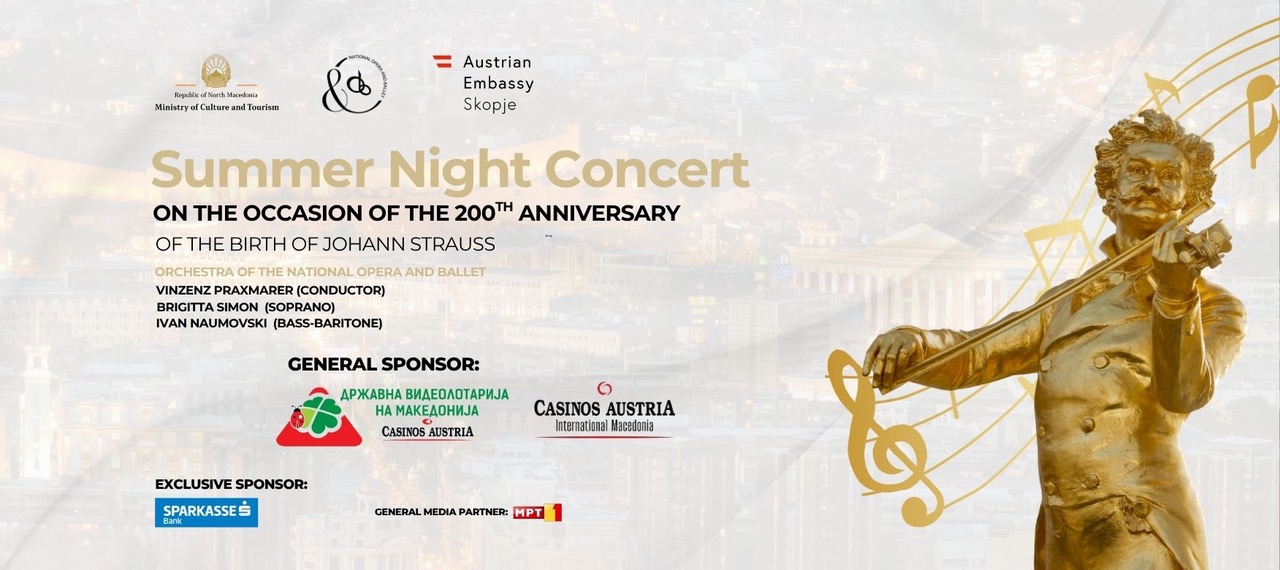
SUMMER NIGHT CONCERT
on the occasion of the 200th anniversary of the birth of Johann Strauss II
July 5th, 2025, 9 pm
Mother Teresa Square
(plateau in front of the National Opera & Ballet)
Conductor: VINZENZ PRAXMARER
BRIGITTA SIMON, soprano (Hungary)
IVAN NAUMOVSKI, baritone
ORCHESTRA OF THE NATIONAL OPERA AND BALLET OF THE REPUBLIC OF NORTH MACEDONIA
Johann Strauss II
Born on October 25, 1825, in Vienna, Austria
Died on June 3, 1899, in Vienna
Johann Strauss II, affectionately known as the “Waltz King,” was one of the most celebrated composers of the 19th century and a central figure in the world of light classical music. Born in Vienna into a musical family, he was the eldest son of Johann Strauss I, himself a successful composer and conductor. Despite his father’s initial opposition, Strauss II pursued music with determination, eventually surpassing his father’s fame and redefining the waltz as an art form.
Strauss composed over 500 works, including waltzes, polkas, marches, quadrilles, and more than a dozen operettas. His music captured the elegance, charm, and energy of Viennese life. His most iconic piece, An der schönen blauen Donau (The Blue Danube), premiered in 1867 and remains one of the most enduring and recognizable orchestral works of all time.
Among his stage works, operettas such as Die Fledermaus (1874) and Der Zigeunerbaron (1885) continue to enchant audiences with their wit, infectious melodies, and brilliant orchestration. These works helped lay the groundwork for the golden age of operetta and later influenced composers such as Franz Lehár and even early Broadway.
Strauss’s music is marked by its rhythmic vitality, graceful phrasing, and rich orchestration. His waltzes, often starting with a gentle introduction before building to lively, flowing dance themes, epitomize the elegance of 19th-century Vienna. Though often labeled as “light” music, Strauss’s compositions reveal a high level of craftsmanship, emotional nuance, and enduring appeal. His ability to blend refinement with popular appeal has ensured his place as one of the great masters of the Romantic era.
Program
- Overture to “Prinz Methusalem”
This operetta is a satire of political intrigue, courtly hypocrisy, and the constant struggle for power and prestige of the 19th century, yet told with Strauss’s signature lightness. The story follows the young and inexperienced “Prinz Methusalem”, surrounded by conspirators and rebels. The operetta premiered on January 3, 1877, at the Carltheater in Vienna.
- Mein Herr Marqis Couplet (8) from “Die Fledermaus” – Soprano
Also known as “Adele’s Laughing Song,” this dazzling coloratura aria is a witty commentary on mistaken identity and social status. A showpiece of comic elegance and vocal fireworks.
- Als flotter Geist 2 from “Der Zigeunerbaron”– Baritone
Is the comic introductory aria of the character Zsupán, a wealthy and boastful pig farmer, from Johann Strauss II’s operetta “Der Zigeunerbaron”. With lively rhythms and humorous bravado, the piece sets the tone for Zsupán’s extroverted personality and adds charm and wit to the operetta’s opening scenes.
- Geschichten aus dem Wienerwald, Waltz op. 325
One of Johann Strauss most famous and atmospheric waltzes. Composed in 1868, it evokes the idyllic charm of the Viennese forest landscape and incorporates a distinctive zither solo in its original version. The piece blends lyrical melodies with lively dance rhythms, capturing the nostalgic spirit of 19th-century Vienna.
- Tritsch-Tratsch, fast Polka, op. 214
A brisk, witty polka reflecting the lively spirit of Viennese social life. Composed in 1858, it remains one of Strauss’s most beloved works, full of rhythmic charm and humour.
- Episode, Polka française op. 296
Written for the student ball of 1865 during a period of illness, this elegant French-style polka was premiered in the grand halls of the Vienna Hofburg. It brings a salon-like grace and charm to the concert.
- Das Eine kann ich nicht verzeih’n, 7 (from “Wiener Blut) – Duet
A passionate duet in which love and jealousy face off with sparkling wit. The operetta Wiener Blut, compiled by Adolf Müller Jr., premiered on October 26, 1899, at the Carltheater in Vienna.
- Kaiser Franz Joseph I: Rettungs-Jubel-Marsch, 126
Composed in response to the attempted assassination of Emperor Franz Joseph I in 1853, this patriotic march expresses Strauss’s loyalty to the monarchy. It premiered shortly after the event at the popular Viennese dance venue Zum Sperl.
- Kaiserwalzer, Waltz op. 437
Originally titled Hand in Hand, this noble waltz was composed in 1889 to mark the friendly meeting between Emperor Franz Joseph I and German Emperor Wilhelm II. It is one of Strauss’s most majestic and charming waltzes.
- Overture to “Der Zigeunerbaron”
A vibrant, dramatic concert overture combining Hungarian folk color with Strauss’s operetta brilliance. Premiered in 1885, the overture presents key themes from the operetta in a lively and rousing form.
- Werberlied 12 ½ from (Song from “Der Zigeunerbaron”) – Baritone
Sung by Count Homonay, a Hungarian officer, this bold baritone aria is a half-serious, half-humorous call to arms. Full of patriotic flair and exaggerated military imagery, it’s both stirring and ironic.
- Wer uns getraut 11 (from” Der Zigeunerbaron”) – Duet
A lighthearted, romantic duet celebrating love, marriage, and a happy ending. A charming moment of reflection and optimism within the operetta.
- Banditen -Galopp 378
A musical romp full of mischief and speed, based on themes from the operetta “Prinz Methusalem”. Composed in 1877, it races forward like a comic chase scene, classic Strauss fun.
- Frühlingsstimmen, Waltz op. 410 – Soprano
One of Strauss’s most famous concert waltzes. Here, spring is celebrated in sparkling coloratura passages and lush melodies. Composed in 1883, it was dedicated to soprano Bianca Bianchi, who performed the premiere on March 1, 1883, at the Theater an der Wien.
- Csárdás from “Ritter Pásmán”
This fiery and virtuosic Hungarian-style dance comes from Strauss’s only opera, Ritter Pásmán, premiered in 1892. The Csárdás, performed in the ballet interlude of Act 3, features dramatic contrasts between slow, expressive sections and fast, rhythmically driving passages. It showcases Strauss’s flair for exotic color and his deep fascination with Hungarian folk music.